EC Fan Guide: How Electronically Commutated Fans Work
An EC fan uses an electronically commutated motor with integrated electronics to move air efficiently across a range of speeds. This guide explains how EC fans differ from AC fans, which factors matter when specifying a fan, and how Sanxin makes EC axial fans for HVAC equipment.
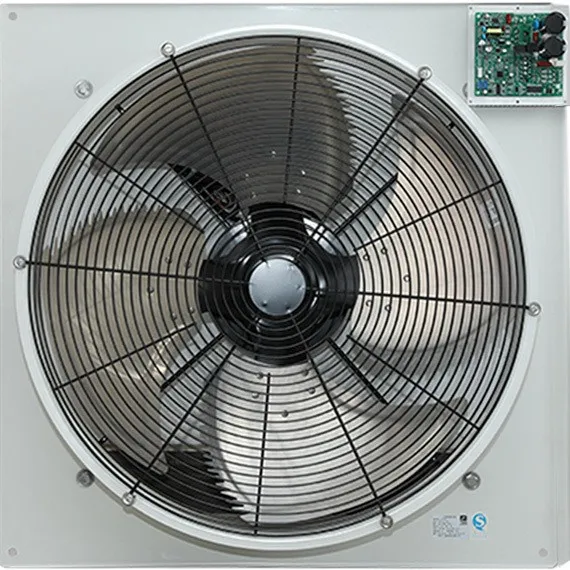
What Is an EC Fan and How Does It Differ from an AC Fan?
An EC fan is a fan driven by an electronically commutated motor whose electronics are integrated with the motor. The electronics convert the incoming AC supply to the form the motor needs and switch the stator windings electronically, so speed and torque are managed inside the fan. In HVAC air movement, this fan type is chosen when the duty needs controllable speed, efficient part-load operation and a compact drive arrangement. It can be supplied as an axial fan for outdoor units, condensers and general ventilation, or as a centrifugal fan for ducted work. The same fan can serve supply or exhaust duty in air-conditioning and ventilation equipment.
A standard AC fan usually runs at a speed set by the supply frequency and the motor winding design. It can reduce speed as demand falls, which lowers power use at partial load instead of running at full speed and throttling airflow. Speed control is built into the motor electronics, so the fan can follow an analogue or pulse-width control signal without external drive hardware. At reduced speed, blade passing and air turbulence are lower, so the fan is often quieter. Control options can include remote start, enabling, fault signalling and speed feedback, depending on the fan design.
- Airflow and static pressure at the required duty point
- Supply voltage and frequency available at the installation
- Control signal expected from the building or equipment control system
- Mounting position, available space and airflow direction
- Ambient temperature, moisture, dust and other operating conditions
- Service access for cleaning and inspection
Sanxin manufactures EC axial fans for air-conditioning outdoor units and other air-moving duties. Send the application details, including required airflow, static pressure, supply voltage, control signal, mounting arrangement and operating environment, to Sanxin to receive a quotation. Sanxin replies to inquiries within 12 hours on working days.
EC axial fan specifications
| Model | Rated power | Rated speed | Phase | Rated voltage | Frequency | Motor protection class |
|---|---|---|---|---|---|---|
| ECDZF9.1C-24×4 | 2200W | 200~950rpm | Three-phase | AC380V+10% | 50Hz | IP55 |
| ECDZF8.5C-25×4 | 1800W | 200~950rpm | Three-phase | AC380V±10% | 50Hz | |
| ECDZF8C-27×4 | 1500W | 200~950rpm | Three-phase | AC 380V±10% | 50Hz | IP55 |
| ECDZF7.6-26×4 | 1100W | 200~950rpm | Single-phase | AC220V±10% | 50Hz | IP55 |
| ECDZF7.1C-24×4 | 750W | 200~950rpm | Single-phase | AC220V+10% | 50Hz | lP55 |
| ECLZF6.3-35×6 | 750W | 200~950rpm | Single-phase | AC220V±10% | 50Hz | IP55 |
Matching EC Fan Performance to an Air-Conditioning Unit
EC fan selection starts at the duty point, where required airflow meets system static pressure. The fan curve and the system resistance curve should intersect at or near the intended operating point, with some margin for filter loading, duct leakage or coil fouling. A fan chosen only on free-air airflow can run short of pressure once the unit is assembled. The EC axial fan table below sets out rated power, rated speed, phase, rated voltage, frequency and motor protection class for the range.
Installation conditions affect the usable performance as much as the catalogue curve. Inlet and outlet obstructions, sharp bends and close guard spacing add resistance and can disturb airflow. The fan should be mounted so that its airflow direction matches the unit layout and so that service access remains possible. For outdoor air-conditioning units, the motor and electronics need protection suited to rain, dust and temperature swings. The operating environment should be checked for moisture, corrosive air, fibrous dust and ambient temperature, because these factors influence motor protection class and housing finish.
- Confirm the duty point against the unit’s measured resistance
- Check supply voltage, frequency and control signal compatibility
- Review mounting direction, clearance and service access
- Match motor protection and coating to the operating environment
- Agree inspection points and finished-product inspection requirements
Maintenance planning should include access to the fan and impeller for cleaning, a check of mounting fastenings and a review of the control signal history where the equipment provides it. Dust build-up on blades changes balance and airflow, so cleaning intervals should match the site conditions. If a fan is replaced, the new unit should match the mounting interface, airflow direction, supply voltage and control signal of the existing installation. Recording the duty point and settings helps keep later replacements consistent. A simple record of the fan setting and replacement date supports maintenance planning.
How Sanxin Produces and Supplies EC Axial Fans
Zhejiang Sanxin Technology Co., Ltd. (Sanxin) is a fan manufacturer based in Xinchang, Zhejiang Province, China. Established in 2001, Sanxin integrates R&D, production, sales and service, and makes EC axial fans alongside axial flow fans, centrifugal fans, HVLS industrial ceiling fans, livestock fans, fan blades, guards, misting fans and anti-frost fans. Annual production exceeds 200,000 units. Production bases in Shaoxing and Huzhou in Zhejiang Province and in Guangzhou, Guangdong Province, support this output, with a central R&D centre in Hangzhou and an international marketing centre in Hong Kong.
Sanxin’s engineering and quality resources are sized for custom fan work. The company has 14 R&D engineers and 10 QA/QC inspectors among 101–200 employees. Production runs through 3 independent workshops for fan components, a spraying shop, and 2 self-owned production lines with 12 production machines, within 12,396 m² of floor space. Products are inspected after every process, and finished products receive 100% inspection to the customer’s requirements. A testing lab and inspection equipment support fan testing.
Sanxin offers OEM and ODM production, with designs developed by its own engineering team and mould factory, and makes customized fans and parts to customers’ drawings or samples. Quotations are on FOB, CIF or CNF terms as agreed with the buyer. Nearest ports are Ningbo and Shanghai. Main markets outside China are North America, Southeast Asia, Eastern Europe and Western Europe. Sanxin develops about 30 new products a year and replies to inquiries within 12 hours on working days.
Request a quotation
Describe the application, space and power supply, and we will suggest a model.
Or write to sales@axialfansupplier.com