Backward Curved Centrifugal Fan Guide for B2B Buyers
A backward curved centrifugal fan uses a backward-inclined impeller to move air into a scroll housing and out to the duct or coil. Sanxin builds centrifugal fans to drawings or samples and supplies backward curve impellers for equipment projects.
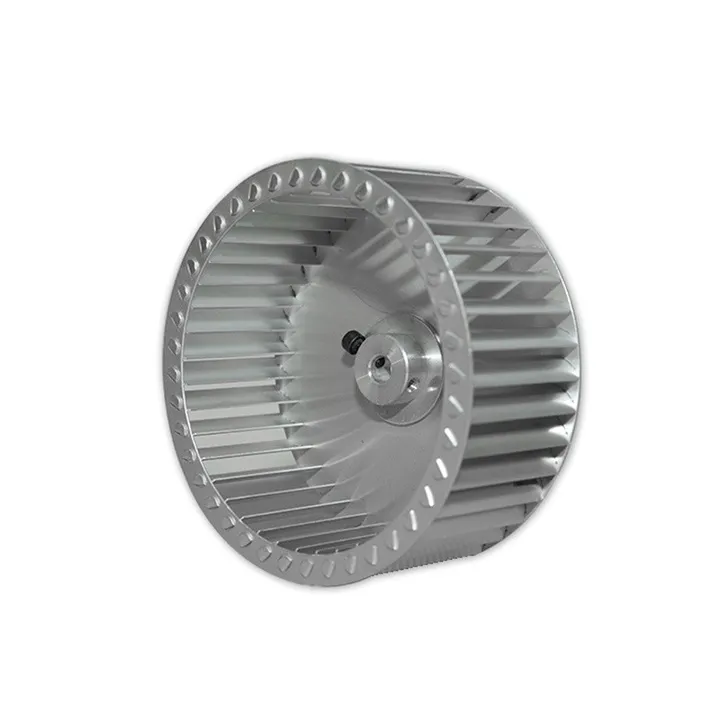
Choosing a Backward Curved Centrifugal Fan Over Other Centrifugal Types
A backward curved centrifugal fan takes air in at the impeller eye. The backward-inclined blades accelerate that air outward, and the scroll housing turns the flow through roughly a right angle to the outlet. The blade shape is generally chosen for higher efficiency, lower noise and a non-overloading power curve compared with forward-curved impellers. Its open, swept blade form also resists dust build-up, which matters where the air stream carries particles or where cleaning access is limited.
Compared with a forward-curved centrifugal impeller, a backward-curved impeller usually gives a more stable power characteristic as system resistance rises. That makes it a practical choice for ducted systems, coil duties and equipment that may run across a range of operating points. Sanxin offers a centrifugal backward curve impeller and metal backward impellers, and builds centrifugal fans to drawings or samples. Send the required airflow, static pressure and installation details so the fan can be selected around the actual duty point.
Backward-curved impellers are not the answer for every low-pressure, high-volume task. Where the system resistance is low and space is tight, a forward-curved centrifugal fan may fit the housing better. The useful comparison starts with the duty point, not the blade name: airflow, static pressure, air temperature, dust load and the way the fan connects to the duct or coil decide which impeller shape is suitable.
Centrifugal fan specifications
| Model | Motor | Phase | Rated voltage | Frequency |
|---|---|---|---|---|
| EK630-0I3-A001 | EC4.2kW | 3-phase alternating current | AC400V | 50-60 Hz |
| EK560-0I3-A001 | EC5.9 kW | 3-phase alternating current | AC400V | 50-60Hz |
| EK500-0I3-A001 | EC7.0kW | 3-phase alternating current | AC400V | 50-60 Hz |
| Ek450-0I3-A001 | EC5.2 kW | 3-phase alternating current | AC400V | 50-60 Hz |
| EK400-0I3-A001 | EC3.6kW | 3-phase alternating current | AC400V | 50-60Hz |
| EK355-0I3-A001 | EC2.7 kW | 3-phase alternating current | AC400V | 50-60 Hz |
| EK310-0I3-A001 | EC3.0kW | 3-phase alternating current | AC400V | 50-60 Hz |
| EK280-0I3-A001 | EC1.0kW | 3-phase alternating current | AC400V | 50-60 Hz |
| Ek250-0I3-A001 | EC1.2 kW | 3-phasealternating current | AC400V | 50-60Hz |
| Type | Voltage (V) | InputPower (w) | AirVolume (m³/h) | Speed (r/mim) | Lpa (dB(A)) |
|---|---|---|---|---|---|
| φ396*92(112) | 380 | 850 | 5400 | 2550 | 71 |
| φ430*92(112) | 380 | 950 | 6200 | 2350 | 75 |
| φ445*124.5 | 400 | 1380 | 4600 | 1340 | 72 |
| φ470*147 | 380 | 1380 | 7260 | 1850 | 78 |
| φ500*94(114) | 380 | 1380 | 8000 | 1780 | 75 |
Backward Curved Centrifugal Fans: Impeller Shape and Typical Duties
A centrifugal fan draws air in axially through the inlet and impeller eye, accelerates it radially with the blades, and discharges it through a scroll casing at roughly a right angle to the inlet. An axial flow fan moves air along the shaft axis and suits high-volume, lower-pressure duty, while a centrifugal unit is typically used where more pressure is needed to push air through ducting or a coil. Sanxin makes axial flow fans as well as centrifugal fans, so both types can be compared for the same project.
A centrifugal blower fan has a performance curve of airflow against static pressure, and it operates where that curve meets the system resistance curve of the ductwork or machine. Adding resistance moves the duty point and reduces airflow; changing impeller speed moves the fan curve. For an industrial centrifugal fan, send required airflow, required static pressure, air temperature, air density or altitude, duty cycle and duct layout. The duty point, not a nominal free-air figure, is the basis for a useful proposal.
- Required airflow and static pressure at the actual duty point
- System resistance from ducts, filters, coils, bends and outlets
- Air temperature, dust load and moisture load
- Continuous or intermittent duty, and the space and orientation available
- Impeller drive arrangement, material and coating for the environment
- Noise limits, plus access for cleaning and maintenance
An impeller fan is simply a fan whose air-moving element is the impeller, and the blade shape sets its pressure and airflow behaviour. Sanxin supplies complete centrifugal fans, forward-inclined centrifugal fans with single-side and double-side air inlet, a centrifugal backward curve impeller and high quality metal backward impellers, plus fan blades and fan guards. Buyers can send drawings or samples for customized fans and fan parts.
How a Backward Curved Centrifugal Fan Works
In industry, the terms centrifugal fan, centrifugal blower fan, centrifugal blower and centrifugal air blower are used largely interchangeably for the same machine. Blower is often used informally where the duty involves ductwork or higher pressure, but the name does not change the aerodynamics or the selection process. What matters is airflow, static pressure, air temperature and cleanliness, plus how the unit is mounted and driven. Sanxin’s centrifugal range includes forward-inclined centrifugal fans with single-side and double-side air inlet and a backward curved impeller option.
Build quality shows in impeller balance and blade fixing, housing and frame rigidity, bearing and drive arrangement, coating of the housing and impeller, and consistency between units. Sanxin has 3 independent workshops producing fan components and a spraying (coating) shop serving its products. Sanxin also has its own testing lab and inspection equipment, inspects products after every process and carries out 100% inspection of finished products to the customer’s requirements. Ask for the duty point, materials and mounting arrangement to be stated in the quotation.
A centrifugal air blower is tested on its own, and installation adds resistance from ducting, filters, coils, bends and outlets. That resistance moves the operating point along the fan curve and lowers delivered airflow. Air density changes with temperature and altitude, and leakage, obstruction at inlet or outlet, wrong rotation direction, or drive and speed differences can have the same effect. Check the system before blaming the fan. Sanxin can review the duty point and duct arrangement when a buyer sends them with an inquiry.
For an industrial centrifugal blower built to a drawing and duty cycle, Sanxin handles R&D, production, sales and service. Sanxin was established in 2001 in Xinchang, Zhejiang. It has production bases in Shaoxing, Huzhou and Guangzhou, a central R&D centre in Hangzhou, 14 R&D engineers and 10 QA/QC inspectors. About 30 new products are developed a year, and annual production exceeds 200,000 units. Customized fans and fan parts are made to customers’ drawings or samples, with inspection after every process and 100% inspection of finished products. Inquiries are answered within 12 hours on working days, and quotes are on FOB, CIF or CNF terms as agreed.
Rotation, Installation and Maintenance Checks for Centrifugal Fans
Correct rotation matters. A centrifugal impeller must turn in the direction set by the scroll housing and blade inclination; running it backward reduces airflow and raises noise. Forward and reverse refer to the direction of rotation relative to the housing, not to a separate fan type. Check the rotation arrow or marking on the housing, confirm that motor wiring gives the intended direction, and compare airflow and pressure after the unit is connected. If the impeller is supplied without a housing, the blade orientation and outlet position still define the correct direction of rotation.
Installation affects the duty point as much as the fan curve. Keep inlet and outlet clear, align ducts without strain on the casing, use flexible connections where vibration must be isolated, and leave access for cleaning the impeller and scroll. During maintenance, watch for dust build-up that disturbs balance, check bearing condition and drive alignment, and renew coating where the housing or impeller is exposed to moisture or corrosive air. A fan that is clean and correctly aligned holds its airflow better.
- Confirm the rotation arrow and actual direction of the impeller
- Check inlet and outlet clearance and duct alignment
- Look for dust build-up, blade damage or coating wear
- Check bearing condition, drive alignment and fasteners
- Record airflow and pressure after installation
Request a quotation
Describe the application, space and power supply, and we will suggest a model.
Or write to sales@axialfansupplier.com